TL;DR
Researchers from the University of Reading and the Animal and Plant Health Agency tested violet-blue photodynamic inactivation on 64 Campylobacter strains. The study report says the treatment killed every strain tested, including strains with different antibiotic resistance profiles, but further trials are needed to determine its practical value for chicken safety.
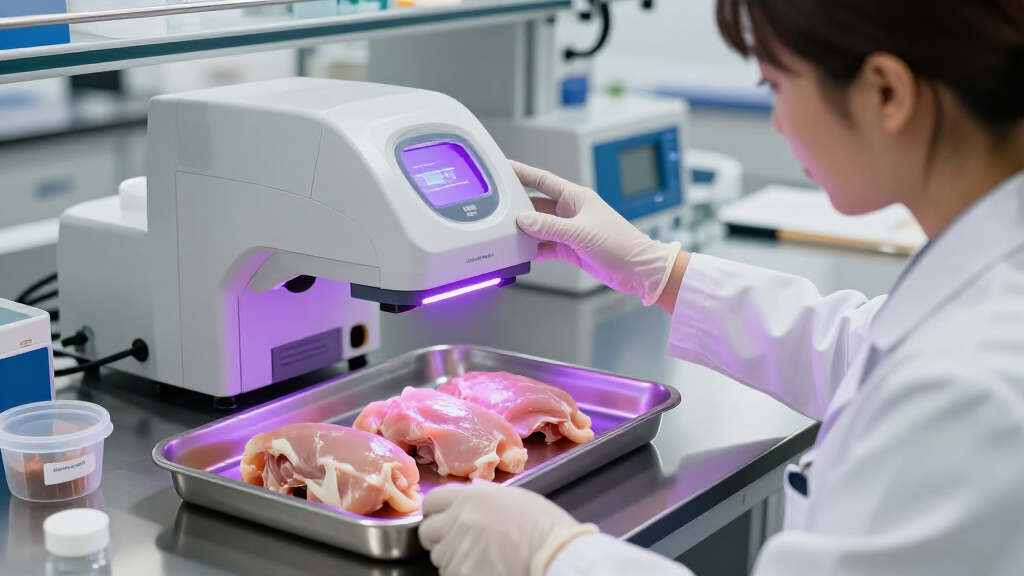
Researchers from the University of Reading and the Animal and Plant Health Agency report that a violet-blue light treatment killed all 64 Campylobacter strains tested, including strains with different antibiotic resistance profiles. The method does not require physical contact with food or added chemicals, but the researchers say more trials are needed before its promise as a way to reduce the bacteria on chicken can be established.
The researchers tested a method called violet-blue photodynamic inactivation, or VB-PDI, against 64 strains of Campylobacter. According to the study findings summarized by Food Safety News, every strain was killed by the treatment, regardless of species or antibiotic resistance profile. The report does not provide further experimental details, such as the light exposure conditions or how much bacteria was present before treatment.
VB-PDI is described as a contact-free treatment that does not add chemicals to food. That feature could make it of interest for food-processing settings, where researchers are looking at ways to limit contamination. However, the reported result is from testing bacterial strains; the available information does not establish how well the technique works on chicken under commercial processing conditions.
The study’s authors characterize the approach as promising, not as a proven replacement for existing food-safety practices. The report says additional trials are required. It does not specify the number, design or expected timing of those trials, or report whether the treatment has been evaluated at production scale.
A Possible Extra Barrier on Chicken
Campylobacter is a major food-safety concern because contaminated raw poultry can carry bacteria that cause illness. Food Safety News describes it as the most common cause of bacterial gastroenteritis worldwide. It reports that the UK recorded 70,000 laboratory-confirmed cases in 2024 and 2025; the source does not clarify whether that figure covers each year separately or the two years combined.
Cooking kills Campylobacter, but that does not prevent all exposure. The report says cross-contamination while handling raw meat is thought to be a major route of infection. A treatment that could lower contamination on chicken before it reaches kitchens might offer an additional control point. That is a potential implication, not a demonstrated public-health outcome: the available findings do not show that VB-PDI has reduced illness or contamination in food-processing operations.
The treatment’s reported lack of direct contact with food and added chemicals may also be relevant to whether it can be incorporated into processing. Whether it can be applied consistently, at useful scale and without affecting product quality remains to be tested.
As an affiliate, we earn on qualifying purchases.
From Strain Tests to Food Trials
The report describes a laboratory study of 64 Campylobacter strains, conducted by scientists from the University of Reading and the Animal and Plant Health Agency. The breadth of strains matters to the reported finding: the treatment killed those tested across species and antibiotic resistance profiles. It does not, on its own, establish effectiveness against every Campylobacter strain or in every setting.
Campylobacter is killed by proper cooking, according to the report, while raw-meat handling can spread bacteria to other foods, surfaces or hands. The light technique is being explored as a possible intervention earlier in the food chain. The source material presents it as an option under investigation, not as guidance for consumers or a replacement for safe food handling.
The report was published by Food Safety News on October 9, 2026. Its summary does not name a journal, provide the study’s full methods or results, or give details of any testing on chicken. Those limits make it important to distinguish the reported laboratory result from evidence of performance in commercial food production.
“Every strain was killed by the treatment, regardless of species or antibiotic resistance profile.”
— Food Safety News, summarizing the study findings
food-grade violet-blue light sterilization device
As an affiliate, we earn on qualifying purchases.
As an affiliate, we earn on qualifying purchases.
How It Performs on Chicken
The information available does not establish whether VB-PDI has been tested on whole chicken or chicken portions, or whether the reported results can be reproduced under commercial processing conditions. Details such as treatment duration, light intensity, effects on food quality and performance across different processing environments are not given in the report summary.
It is also unclear how the method compares with existing food-safety controls, whether it can reduce contamination enough to affect infection risk, and what further trials are planned. The finding that all 64 tested strains were killed should not be read as proof that every strain will respond the same way in food or in real-world use.
The reported UK case figure is not defined by year in enough detail to determine whether 70,000 cases refers to each of 2024 and 2025 or the combined period. The source provides no further breakdown or comparison baseline.
poultry surface sanitizer UV light
As an affiliate, we earn on qualifying purchases.
As an affiliate, we earn on qualifying purchases.
Further Trials Needed Before Use
The next step identified in the report is additional testing. Trials on chicken and under conditions that reflect food processing would help establish whether the strain-test result translates into a usable intervention. The available source does not give a timetable, trial design or target date for a decision about deployment.
Until such evidence is reported, VB-PDI remains a research-stage approach rather than an established food-safety measure. Consumers should continue to follow standard raw-poultry handling practices and cook chicken thoroughly; the study does not present blue-light treatment as a substitute for those precautions.
campylobacter bacteria reduction light
As an affiliate, we earn on qualifying purchases.
As an affiliate, we earn on qualifying purchases.
Key Questions
What is violet-blue photodynamic inactivation?
VB-PDI is the name of the light-based treatment tested against Campylobacter strains in the study. The report says it does not require physical contact with food or added chemicals, but does not provide technical details of how the treatment was applied.
What did the researchers find?
The study tested 64 Campylobacter strains, and the report says the treatment killed every strain, regardless of species or antibiotic resistance profile. The finding does not establish how the treatment performs on chicken in commercial conditions.
Is the treatment ready to be used on chicken?
That has not been established. The report describes the method as promising but says more trials are needed. It does not provide a timeline or details of planned testing.
Does blue light replace safe cooking and handling?
No. The report says Campylobacter is killed by cooking and identifies cross-contamination from handling raw meat as a possible major route of infection. The study does not recommend replacing safe handling or thorough cooking with light treatment.
Source: rss